
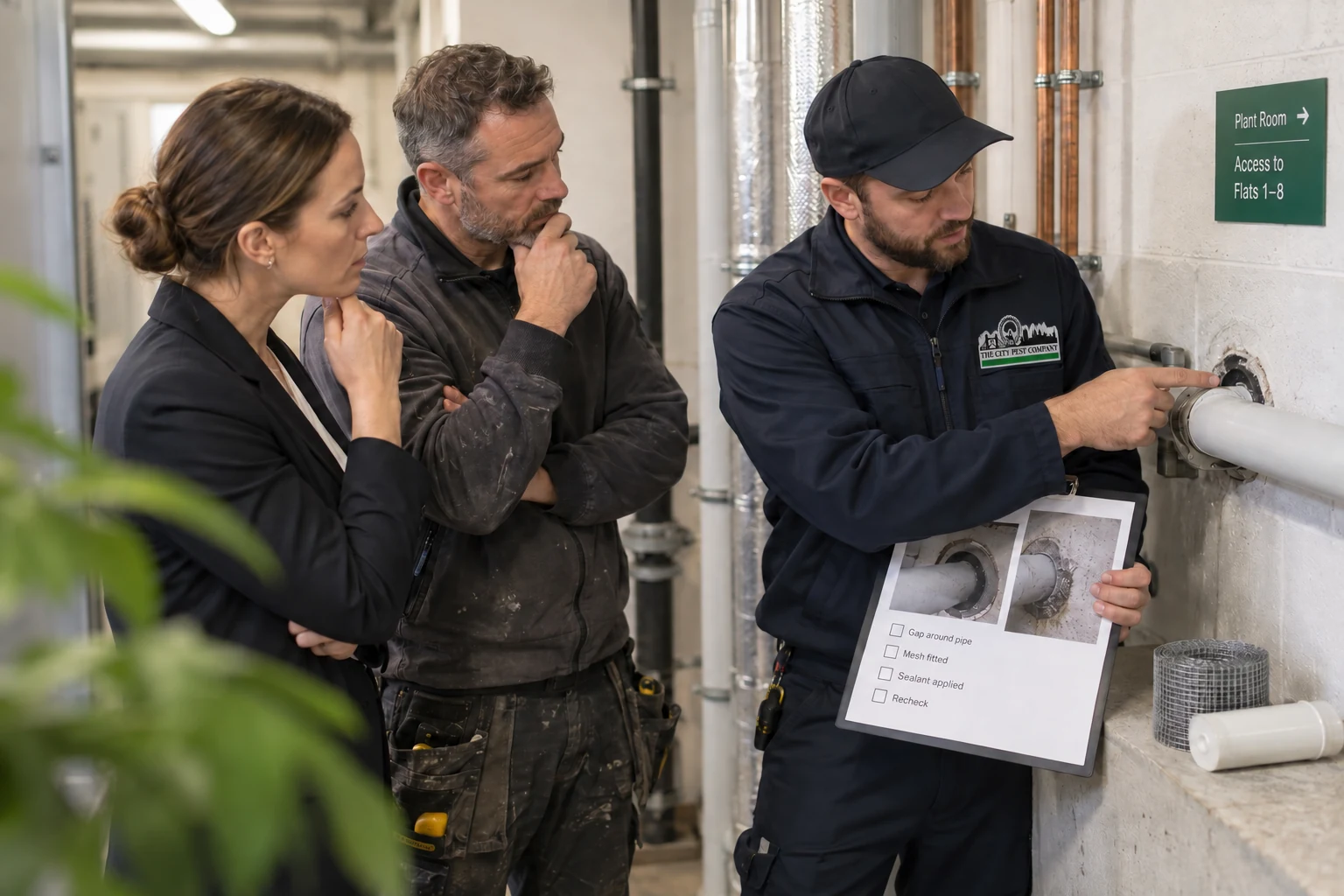
A useful proofing plan turns inspection findings into owned, timed actions. It identifies the route, separates pest-control work from building repair, records who authorises each item, arranges tenant access and verifies completion. It should not declare legal liability from one visit or promise that a building can be made permanently pest-proof.
Ask for findings that another person can act on
“Seal gaps” is too vague for a landlord, maintenance contractor or resident. Ask the inspecting professional to record the room, exact feature, visible evidence, access limits and recommended next step. Photographs should show the property feature without unnecessary belongings or personal information.
Separate confirmed active routes from potential defects. A hole may need repair even when its current pest use is uncertain, but the record should preserve that distinction.
Divide the work into clear scopes
Pest control may address current activity, monitoring and the timing of exclusion. Proofing may involve mesh, sealants or other suitable barriers. Building repair can involve damaged doors, pipes, brickwork, vents, roofs or shared services and may require another qualified trade.
For each line, name:
- the person or organisation approving it;
- the contractor responsible;
- the access or preparation needed;
- any dependency on treatment or monitoring;
- the target date and evidence of completion.
Do not ask a pest technician to alter a gas, electrical, fire-safety or ventilation component outside their competence. Do not let a general repair unintentionally block drainage or airflow.
Coordinate tenant access
Explain what needs to be inspected or repaired, who will attend and which rooms must be accessible. GOV.UK states that private landlords generally give at least 24 hours’ notice for inspection or repairs and visit at a reasonable time, except emergencies. Check the actual tenancy and circumstances.
Ask about work, childcare, mobility, pets, translation or other practical needs. Record if furniture or a fitted unit prevents access and decide who can move it safely. A missed area should remain an open item rather than being treated as complete.
Keep cost responsibility separate
GOV.UK describes general responsibilities for structure, exterior, common areas and tenant-caused damage. Its safe-home guidance includes pest entry and waste considerations. Those principles do not decide every treatment or proofing bill from a single observation.
Check the tenancy, ownership of the affected feature, inspection evidence and current advice. Where parties disagree, obtain appropriate housing or legal guidance. The operational plan can still record what is needed without prejudging who ultimately pays.
Time proofing carefully
Closing a route while animals may still be inside can create another problem. Ask when exclusion is appropriate, what evidence will support that decision and whether monitoring or control must occur first. Consider connected spaces and common routes in a block.
Temporary measures should be labelled as temporary. If a repair waits on another contractor, record the interim control and its inspection date rather than losing it in email.
Verify instead of assuming
Completion evidence can include a dated photograph, contractor note and revisit of the affected feature. The follow-up should ask whether the specified opening was treated, whether the material remains sound, whether new signs exist and whether another route has become apparent.
“Proofing complete” should mean the agreed scope was completed, not that no pest can ever enter the property. Buildings change, materials fail and new routes can appear.
For help coordinating tenants and contractors, see pest control for landlords and agents or call 0203 393 2338.
Use one live action schedule
Keep the plan in one place rather than splitting it across messages from the agent, resident, contractor and technician. Give every item a simple status such as awaiting access, awaiting quote, approved, complete or needs verification. Include the date of the last update and the person expected to act next.
This does not need specialist software. A controlled table can be enough if the latest version is clear and personal details are limited. When a date changes, preserve the reason. That record helps the next visitor understand what remains open without asking the resident to repeat the whole history.
Common questions
Who should approve proofing in a block?
Identify who controls the feature and has authority under the ownership and management arrangements. Do not assume the flat occupier controls a common service route.
Can proofing happen during the first visit?
Sometimes a clearly scoped measure may be appropriate; other work needs investigation, timing or a specialist trade. The quote should say what is included.
How should a proofing guarantee be checked?
Read the written terms. They should state the covered work, duration, conditions and exclusions, so you can distinguish a repair warranty from a broader pest-control promise.
Sources and further reading
External references may contain pest or skin photographs.