
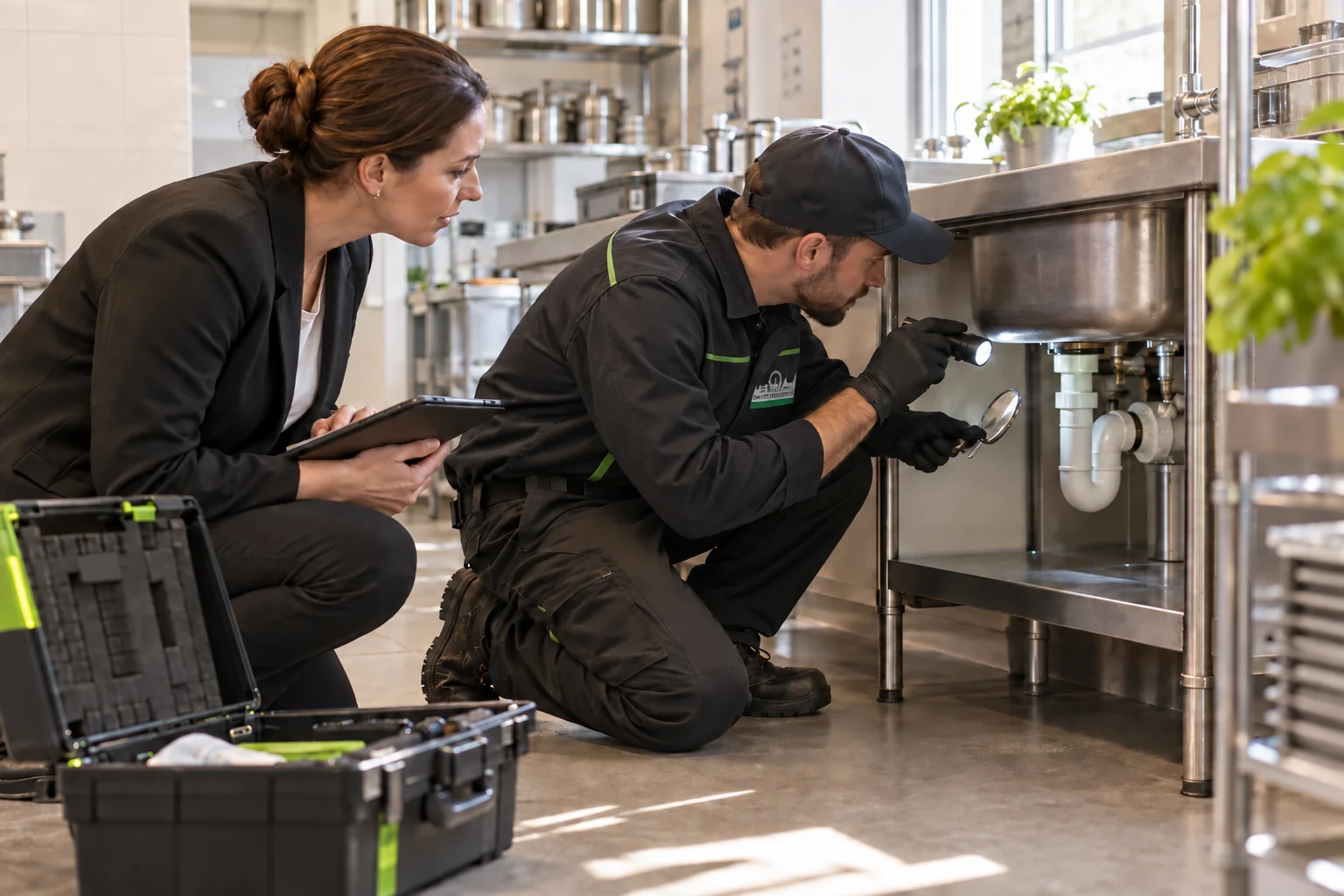
In a shared kitchen, appoint one coordinator, protect food, record the exact sign and preserve access to connected service areas. Communicate to users without blame, and let the appointed professional decide how far the assessment should extend. A spray in the room where one insect appeared is not a building investigation.
Make one factual incident record
Record date, time, exact location, what was observed, who secured any specimen and which food or equipment may have been exposed. Distinguish a confirmed identification from a suspected insect. Limit personal data and avoid sharing close-up images widely.
Nominate a coordinator who can approve access, contact contractors and issue one version of instructions. In workplaces, student housing, HMOs or communal residential kitchens, several people may otherwise take conflicting action.
Protect food and decide whether operations continue
Remove visibly damaged or exposed food from use and follow the applicable food-safety procedure. For a food business, the responsible operator may need advice from the local authority or other competent source about stopping preparation, disposal, cleaning and reopening. A pest contractor should provide findings, not replace the food business’s legal decision-making.
The Food Standards Agency advises businesses to check regularly for pests, maintain premises, inspect deliveries and keep external areas and bins controlled. Record which checks were completed and what changed.
Map the connected areas
Cockroach investigation may involve warm and dark spaces around appliances, sinks, boilers, cupboards, ducting and pipe or cable penetrations. Identify adjacent rooms, risers, cleaner cupboards, waste areas and delivery routes. Do not dismantle electrical or gas equipment.
In a block or multi-unit site, shared service routes may make another area relevant. That does not justify indiscriminate treatment or blame. Ask the professional to explain why additional access is proposed and obtain the necessary permissions.
Control communication
Tell kitchen users what has been found, the immediate hygiene step, what must not be moved or sprayed, and whom to contact. Avoid language suggesting a person or group “brought” the problem without evidence.
Provide instructions in an accessible form and relevant languages. Contractors, cleaners and night staff also need the correct restrictions. Record acknowledgements where the business procedure requires them.
Prevent conflicting products and cleaning
Do not allow staff or occupants to apply sprays, powders or gels independently. The Health and Safety Executive requires biocides to be used for their authorised purpose and according to their label. Food areas, public access and non-target exposure demand a controlled plan.
Cleaning supports control, but timing and surfaces matter. Ask what can be cleaned immediately, what must remain undisturbed and how food-contact areas will be returned to use. Do not wipe away useful evidence before the first assessment unless hygiene safety requires action.
Close the loop after each visit
The report should identify areas accessed, observations, controls, restrictions, inaccessible spaces, repair recommendations and follow-up. Assign owners to leaks, damaged seals, storage problems or waste routines. Verify completion with evidence.
Track new reports by location and time rather than treating every sighting as a new disconnected case. At the same time, do not promise that a quiet period proves resolution.
For coordinated premises support, call 0203 393 2338 or see commercial pest control. Put required reporting and response commitments into the written contract.
Prepare for the follow-up decision
Before the review, assemble new reports, access notes, cleaning records and completion evidence for repairs. Keep “no report received” separate from “area inspected with no sign found”; they are different observations. Confirm that monitors or equipment have remained undisturbed and report any accidental movement.
The follow-up should end with a written next step for every connected area: continue, amend, close with evidence or arrange access. If the professional cannot reach a relevant riser, appliance void or neighbouring unit, that limitation should stay open. A coordinated record helps the site respond proportionately without treating every kitchen user as a separate investigation.
Common questions
Should every connected kitchen be treated?
Not automatically. Evidence and building routes may justify wider inspection. The professional should explain the scope.
Can staff use supermarket spray before the contractor arrives?
Avoid uncoordinated product use. It may be unsuitable for the area and can disrupt the investigation. Follow the approved business procedure.
Who decides when a food kitchen reopens?
The food business operator must follow applicable food-safety requirements and competent advice. Pest findings are one part of that decision.
Sources and further reading
External references may contain pest or skin photographs.