
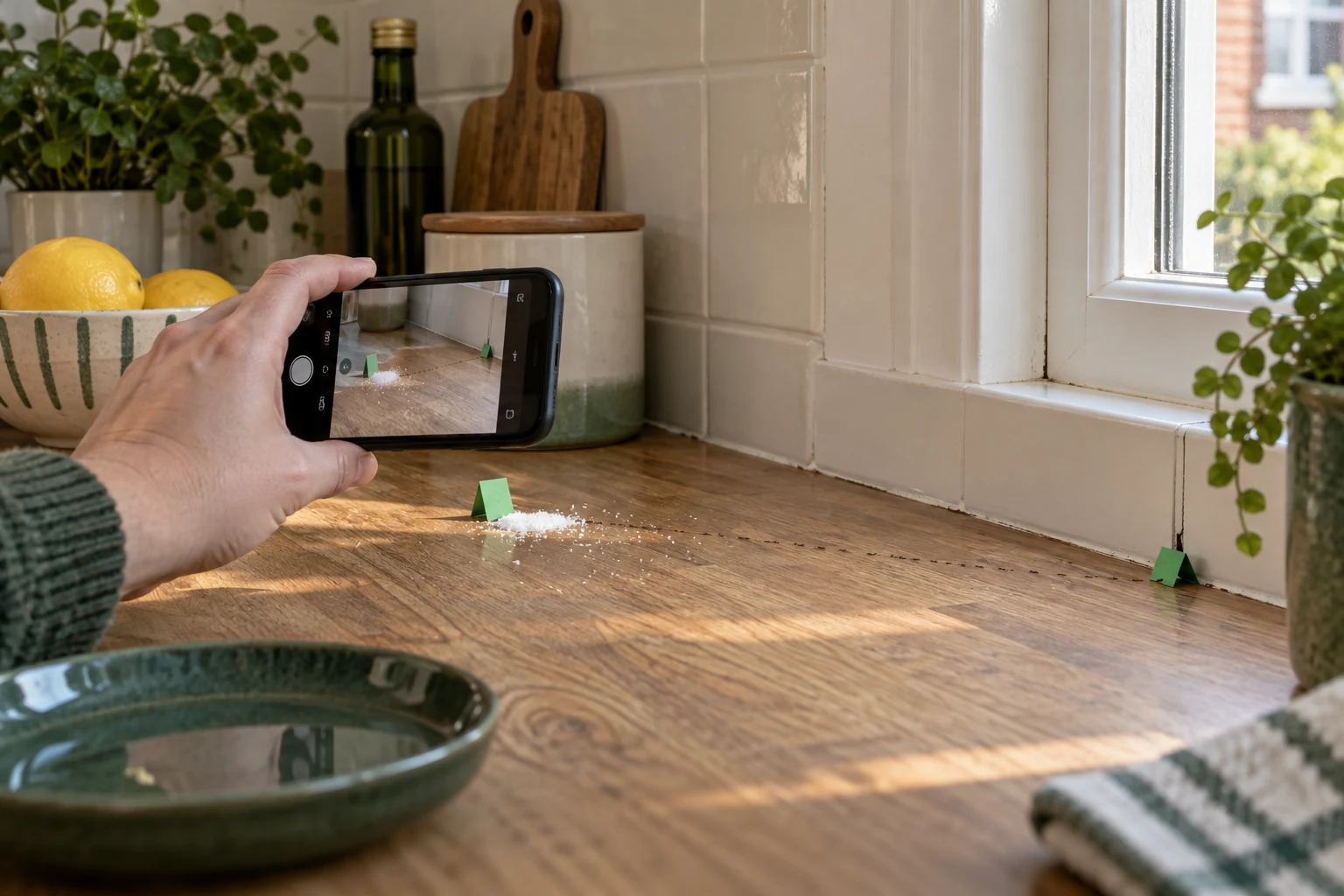
An indoor ant trail shows a route being used; it does not reveal the species or nest location by itself. Record where the line begins and ends, what attracts activity and how it changes during the day before wiping it away.
Map the route precisely
Mark the room, wall or cabinet and the nearest door, pipe, window or floor junction. A short video can show direction better than a still image. Note whether ants disappear beneath a skirting board, arrive around a service penetration or concentrate at a sugary spill, pet bowl or damp area.
Follow only from normal floor level. Do not dismantle kitchen units or open electrical fittings. If the trail crosses a food-preparation surface, protect food and clean the surface using the premises' normal food-safety procedure after the observation has been recorded.
Food explains activity, not necessarily origin
Remove accessible crumbs, spills and open food, then note whether the same route returns. A returning line can indicate that the attractive source or access route remains, but it does not prove “resistance” or treatment failure. Garden ants can travel along established trails to food; other pest ant species have different requirements, so a clear specimen or professional identification matters.
Avoid scattering several baits, powders or sprays along the line before identification. Products can change movement and expose children, pets or food areas if misused. If any product is considered, confirm it is authorised for the intended place and species and follow its label.
What to include in the call
Give the first and latest sighting, trail length, time of day, food or moisture nearby and any previous product. Mention repeated activity in warm service areas or several units because that may change inspection scope. Ask which adjoining spaces matter and whether a specimen is needed.
Repeat observations after ordinary cleaning in the same format. If activity moves from the sink to a window, or appears only after a particular cupboard is opened, that change is useful. Do not turn every sighting into a separate incident; a dated line on the same room sketch makes the route easier to compare. In a shared building, ask whether neighbours have seen a route, but avoid asking them to apply products until the inspection scope is agreed.
Call 0203 393 2338, or read the ant service page.
Frequently asked questions
Should I leave the trail in place?
Record it first. In a food area, restore hygiene promptly. Ask what evidence should remain before an imminent inspection.
Does a trail lead straight to the nest?
Not necessarily. It shows a route between points visible to you; concealed branches or a distant source may exist.
Why did ants return after cleaning?
Cleaning can remove an immediate food source without changing the access route. Record what returned, where and how soon rather than assuming the reason.
Sources and further reading
External references may contain pest or skin photographs.