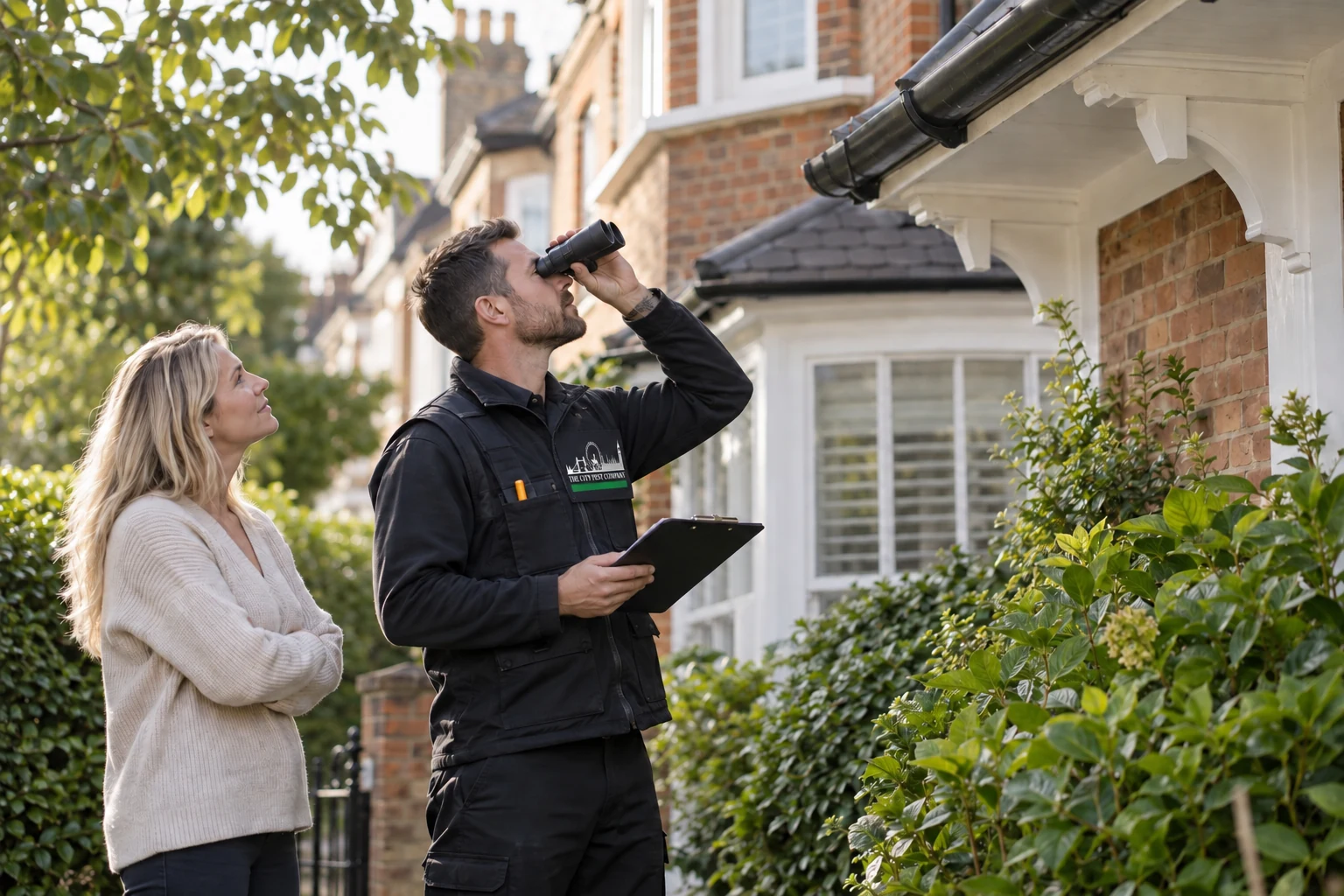
Ask for help when wasps repeatedly use the same point at an eave, tile, vent, wall or roof edge—especially when the route is close to a door, window, balcony or occupied loft. Observe from the ground or another safe place. Do not climb, block the opening or approach it to confirm a nest.
Look for a repeated route
One wasp flying across a garden does not establish a nest in the building. From a safe distance, note whether several insects repeatedly enter and leave the same feature. Record the side of the property, approximate height, time and nearby doors or windows.
Do not stand beneath the route for a photograph. A description such as “under the left eave above the rear bedroom window” is more useful than a risky close-up.
Keep people away without creating panic
Move normal activity away from the immediate flight path where practical. Close a nearby window from inside if that can be done without approaching the insects. Keep children and pets away, and tell anyone working at height or maintaining the roof before they attend.
If someone is stung, use current NHS guidance. Call 999 for signs of a severe allergic reaction, including breathing difficulty or swelling affecting the airway. Pest-control advice is not medical care.
Do not seal the entry point
Blocking an active opening can cause insects to seek another route, potentially into the building. It can also hide the feature that needs assessment. Leave proofing decisions until activity and nest location have been considered.
Similarly, do not spray into a roof opening from a ladder or window. Working at height, uncertain nest position, electrical services and exposure to stings create risks beyond the product itself.
Describe the property context
Tell the company whether the suspected route is at a house, flat, commercial building or shared roofline; whether loft access exists; and whether scaffolding, a balcony or another safe vantage point is already present. Do not promise access equipment or climb into a hot, fragile or restricted loft.
Mention previous treatment and whether builders, roofers or gardeners are due. If the concern may involve a neighbouring property or common roof, contact the relevant owner or manager.
Wasps, bees and other flying insects
Different insects can use roof and wall features. Bees and hoverflies can be mistaken for wasps, so identification affects the practical response. Describe colour, size, shape and behaviour only from a safe distance. You can request a text-only discussion and decide whether to share or view an optional identification image.
If the identity is uncertain, say so. A professional may be able to assess the route or request a securely taken image without requiring you to approach it.
What a quote should explain
Ask what is being assessed or treated, the access assumption, whether equipment or a second person is required, and what happens if the nest cannot be reached. Confirm preparation, people/pet restrictions, follow-up and any proofing that is separate from treatment.
Attendance and the work possible on the day depend on availability, weather, height and safe access. Confirm the proposed timing and any access assumptions when you call.
Read the wasp service guide or call 0203 393 2338 with the postcode and a safe description of the route.
Make access information useful
A safe ground-level photograph of the whole elevation can help identify the relevant eave or vent without asking you to approach it. Mark the feature in a copy if needed, and include an ordinary landmark such as the rear bedroom window. Avoid publishing the image or including house numbers and people unnecessarily.
Tell the company about gates, parking limits, conservatories, fragile roofs, neighbouring access and known loft hazards before attendance. If safe access depends on scaffolding, a tower or another contractor, the quote should identify that assumption. Clear access information reduces uncertainty; it does not guarantee that a nest can be located or treated on the first visit.
Common questions
Should I block the hole at night?
No generic DIY instruction is given. Blocking an active route can cause movement elsewhere and exposes you to the area. Ask for assessment.
Does one wasp indoors mean there is a roof nest?
No. Record where and when it appeared and look for repeated external activity from a safe place.
Can a roof survey confirm the nest?
A visual pest-entry survey may help with accessible external features, but its scope and limits must be agreed. It is not a structural survey or guaranteed nest detection.
Sources and further reading
External references may contain pest or skin photographs.