
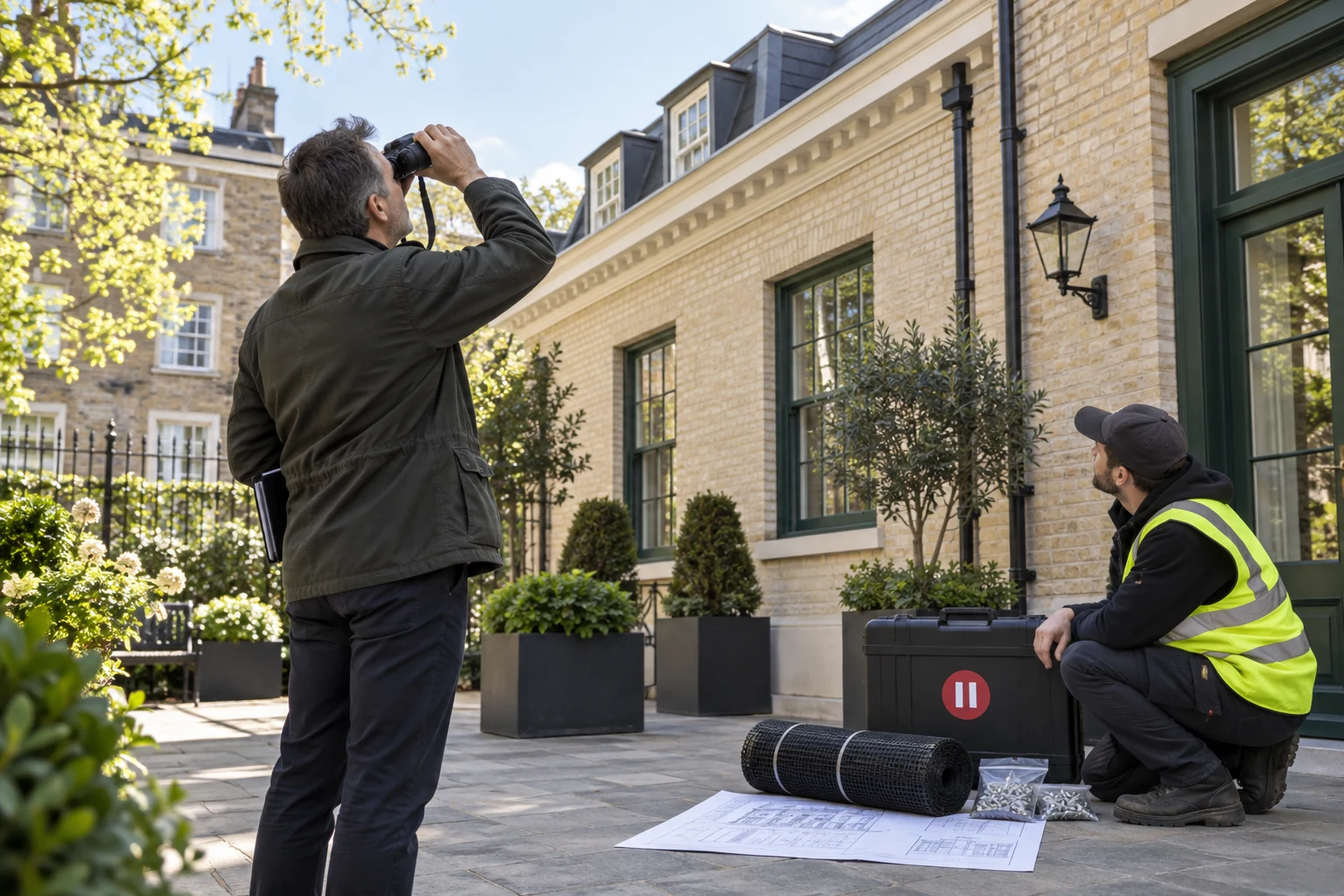
Do not begin proofing simply because birds are present. Establish which areas are being used, whether any nest is active or being built, what work is proposed and who is qualified to assess the legal and access constraints. A survey before installation helps prevent work from trapping birds or interfering with a protected nest.
Start with activity, not a product
Netting, wires and other deterrent systems suit different building shapes and patterns of use. Choosing one from a catalogue before surveying the elevation reverses the sensible order. The first record should mark ledges, recesses, roof edges and access points; distinguish occasional perching from repeated roosting or nesting; and note where cleaning and future maintenance will have to take place.
Photographs taken from a safe, publicly accessible position can support the brief. They should show the whole feature as well as the problem area, because fixings, edges and neighbouring routes matter. Do not lean from windows, climb onto roofs or approach a nest for a closer image. If safe viewing cannot answer the question, specify suitable access for a qualified survey.
In England, GOV.UK guidance says wild birds, their eggs and nests are protected. It is an offence intentionally to take, damage or destroy a wild bird’s nest while it is being used or built, and some Schedule 1 birds have additional protection from disturbance. The same guidance says work should be timed to avoid the breeding season where possible, but a calendar date alone is not proof that a particular nest is inactive. The current site conditions and species need assessment.
Questions for the surveyor or installer
Ask the proposal to name the observed species or explain any uncertainty, describe the activity and record the date of the survey. It should identify each work area rather than describing the whole roof as one zone. Where a nest or possible nest is present, ask how activity will be checked immediately before work and what happens if the position has changed.
The proposal should also explain why the chosen system fits the geometry and how open edges, corners, pipes and access hatches will be handled. A proofing system must be inspectable after installation. Ask how trapped-bird risk will be controlled, how damaged components will be reported, and how window cleaning, gutter clearing, plant access or façade maintenance will continue.
Responsibility matters. Record who can authorise work, who supplies safe access, who coordinates residents or occupiers, and who can stop the job if active nesting is found. If a licence may be relevant, obtain advice on the current licence and its conditions; do not assume that a general licence authorises routine convenience work. The GOV.UK bird-licence collection directs users to read the current licence and advice notices and to consider alternatives.
A practical pre-start check
Imagine a block where pigeons have been seen beneath two balcony soffits. The survey identifies one as a regular perching point and the other as a possible nesting recess. Treating both as identical would hide the key decision. The work brief should separate the areas, record the evidence, arrange a pre-start activity check, and hold the uncertain recess until a competent assessment says how work can lawfully proceed.
Before anyone arrives, circulate the access plan and affected zones. Keep the site contact available, prevent residents from removing nesting material, and confirm whether other contractors will be working nearby. The installer should have a clear route for pausing and escalating unexpected findings rather than improvising on the day.
When to call
Call when you need a survey of recurring bird activity, a review of access and proofing options, or help turning observations into a workable proposal. The City Pest Company can discuss the enquiry on 0203 393 2338; see the pigeon and bird service page for context. The final system, timing and any licensing question remain subject to the site assessment and current rules.
FAQs
Can work proceed outside spring and summer?
Season alone does not establish that a nest is inactive. Check the actual work area before starting and obtain qualified advice where activity is uncertain.
Can an old-looking nest be removed?
Appearance is not enough to decide whether a nest is in use. Record the location and arrange an appropriate assessment before removal or obstruction.
Should the proposal include maintenance?
Yes. It should explain how the installation will be inspected, how defects or trapped-bird concerns are escalated, and how building maintenance can continue.
Does a general licence automatically allow proofing work?
No blanket assumption is safe. Check the current licence purpose, conditions and eligibility, and seek specialist advice for the particular situation.
Sources and further reading
External references may contain pest or skin photographs.