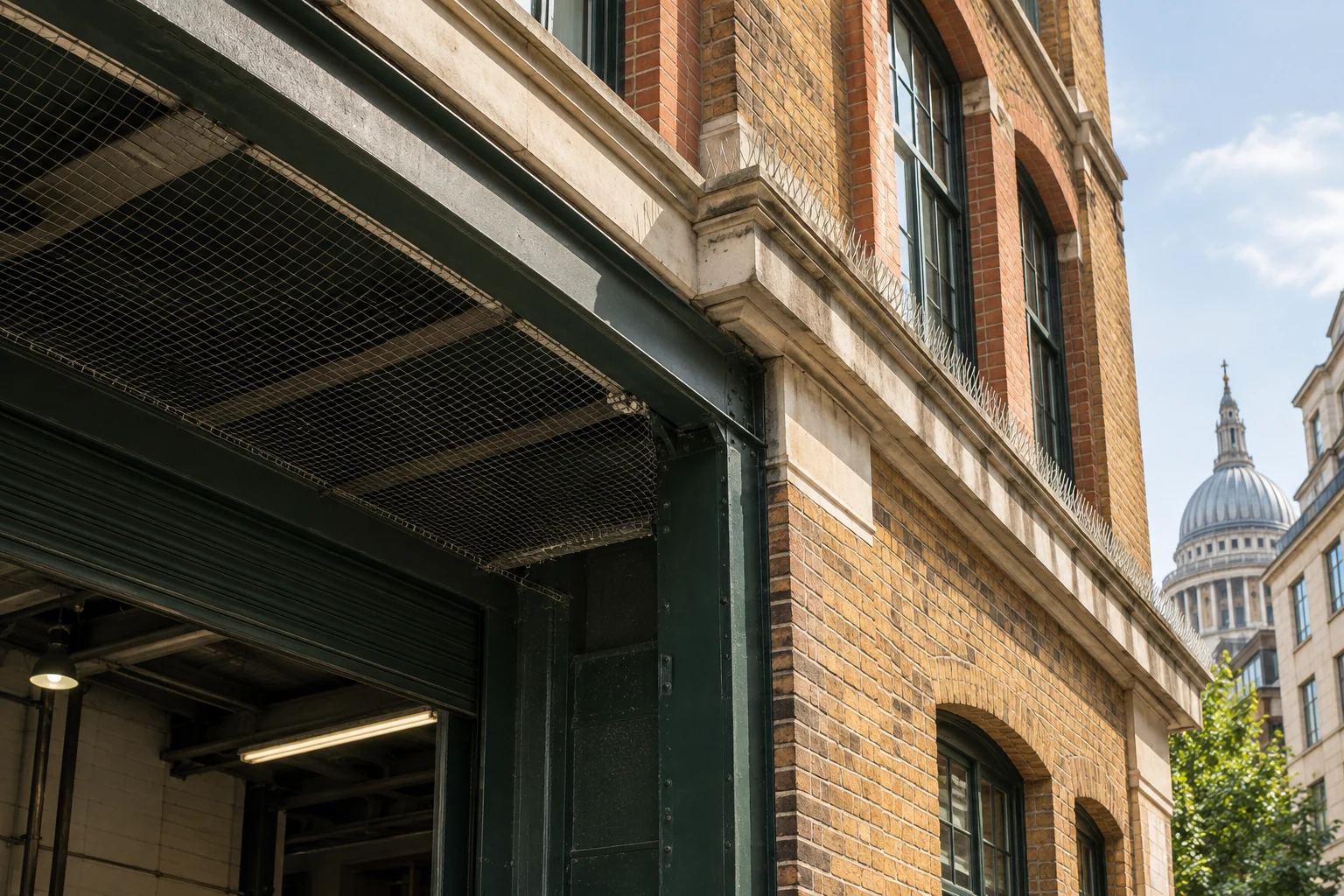
A useful bird-proofing proposal starts with the exact place birds land, enter or nest, then explains why a particular system suits that geometry. Netting can exclude birds from a defined volume; spikes can discourage landing on suitable ledges. Neither is a generic answer, and the plan must include active-nest checks, safe installation and later maintenance.
Ask for a marked photograph or drawing. A line item saying “bird proofing” does not tell a property manager which openings are covered, which remain accessible or how a loose component will be found and repaired.
What netting and spikes are designed to do
Netting forms a barrier across an opening or around an area such as a lightwell, canopy or recessed elevation. Its success depends on the perimeter, joins, fixings and interfaces with pipes, lights, doors and gutters. The proposal should state the covered volume, mesh specification chosen for the assessed species, access panels and how the installer will avoid gaps or trapping points.
Spikes sit on a surface where birds would otherwise land. They may suit a continuous ledge or sign, but they do not close a cavity and cannot compensate for untreated adjacent perches. The drawing should give the length and width of the treated surface and show what happens at corners, downpipes and façade details.
In a hypothetical courtyard, netting might keep birds out of the whole upper recess while a zip or framed panel preserves plant access. On a separate narrow parapet, a ledge system might be proposed. The decision comes from the building shape and observed behaviour, not a preference for one product name.
Wildlife checks come before installation
GOV.UK guidance says it is an offence to intentionally take, damage or destroy a wild bird's nest while it is being used or built, or to take or destroy eggs. Schedule 1 species have additional protection from disturbance. A survey therefore needs to record species where practicable, current activity and any nest before work is programmed.
There is no single calendar date that makes a façade automatically clear. Nesting activity must be checked in the actual location close to the work. If an active nest or uncertain species is found, pause and obtain competent advice on whether the design, timing or a licence needs to change. A contractor's commercial schedule does not override wildlife law.
Access and building operation belong in the design
Map every feature that another person must reach: windows, fire routes, gutters, drains, lighting, cameras, air-conditioning units and cleaning points. Speak to the people who maintain those assets before accepting the system. A proofing measure that is repeatedly opened, cut or left loose for routine servicing will not remain an effective barrier.
The proposal should also explain the access method for installation and inspections. Roof or façade access, permits, exclusion zones and specialist equipment may involve separate contractors and approvals. Agree which survey, access arrangements and deliverables are included for your building, so they need to be agreed for the individual site.
Put maintenance into the quote
Record who owns the post-installation checks, their frequency, the reporting route and the response if damage or entrapment is suspected. Inspections should cover tension, fixings, perimeter gaps, corrosion, debris loading and any changes made by other trades. Cleaning arrangements should be clear as well; proofing does not remove existing fouling or repair damaged finishes by itself.
Ask whether the price includes survey drawings, installation access, cleaning, disposal, making good, return visits and repairs after third-party work. Confirm VAT, parking, permits and out-of-hours access rather than assuming they are included.
Call The City Pest Company on 0203 393 2338 to discuss the site and what a survey would need to cover. The pigeon and bird service page gives the relevant service route. A short written enquiry can follow with safe ground-level photographs and the building contact.
Frequently asked questions
Are spikes harmful to birds?
They are intended to deter landing, but suitability and installation still matter. A poorly chosen or maintained system can create gaps or hazards, so the proposal should explain the surface, species and inspection plan.
Can proofing be installed beside a nest?
Do not assume it can. Active nests, eggs and some disturbance are legally protected. The site-specific wildlife check should decide whether work pauses or needs specialist advice.
Is netting maintenance-free?
No. Perimeters, fixings, joins and access panels can be affected by weather and other building work. Assign inspection and repair responsibility from the start.
Should every ledge be treated?
The survey should target demonstrated or credible routes while preserving necessary building access. Treating an unused ledge may add cost without solving movement from an adjacent untreated feature.
Sources and further reading
External references may contain pest or skin photographs.